
Virtual Tarzan - Transformation Architect
  • Home
  • About
  • Contact me

Recent Comments

  • Pane on Cloud Chaos to Cloud Control: The Governance Playbook You Need Now
  • TJ on Cloud Chaos to Cloud Control: The Governance Playbook You Need Now
  • Mike A on Cloud Chaos to Cloud Control: The Governance Playbook You Need Now
  • Virtual Tarzan on Crafting an Effective Enterprise Multicloud Strategy
  • James on Crafting an Effective Enterprise Multicloud Strategy

Categories

  • AI-ML
  • Azure Architecture
  • Citrix
  • Cloud
  • Cloud Architecture
  • Cloud Security
  • Cloud Strategy
  • Compliance
  • Digital Transformation
  • EUC
  • General
  • Infrastructure Design & Architecture
  • IT Strategy
  • Networking
  • Storage
  • Troubleshooting
  • vCloud
  • VMware
  • vSphere

Archives

  • September 2024
  • July 2024
  • June 2024
  • March 2024
  • January 2024
  • October 2023
  • August 2023
  • July 2023
  • April 2023
  • February 2023
  • January 2023
  • September 2021
  • June 2021
  • January 2021
  • November 2020
  • July 2020
  • April 2020
  • March 2020
  • February 2020
  • January 2020
  • December 2019
  • November 2019
  • October 2019
  • September 2019
  • August 2019
  • July 2019
  • June 2019
  • May 2019
  • April 2019
  • March 2019
  • February 2019
  • January 2019
  • July 2018
  • April 2018
  • March 2018
  • February 2018
  • January 2018
  • December 2017
  • November 2017
  • October 2017
  • January 2017
  • October 2016
  • April 2016
  • March 2015
  • January 2015
  • November 2014
  • October 2014
  • September 2014
  • May 2014
  • April 2014
  • March 2014
  • February 2014
  • August 2013
  • March 2013
  • January 2013
  • December 2012
  • November 2012
  • October 2012
  • September 2012
  • August 2012
  • July 2012
  • June 2012
  • May 2012
  • April 2012
  • March 2012
  • February 2012
  • January 2012

Follow me

Virtual Tarzan - Transformation Architect
  • Home
  • About
  • Contact me
Storage,

Not all I/Os are created equal

IOPS are a very important piece of any design and usually most misunderstood. In many cases using average IOPS collected is good enough, but often that is not enough and if the application in question is mission critical then you have a major issue.

But first for those who are not familiar with the term IOPS. IOPS stand for Input/Output Operations Per Second. It is the standard measurement used to measure performance of storage.


There are four types of IOPS that we need to consider when we are doing an analysis:
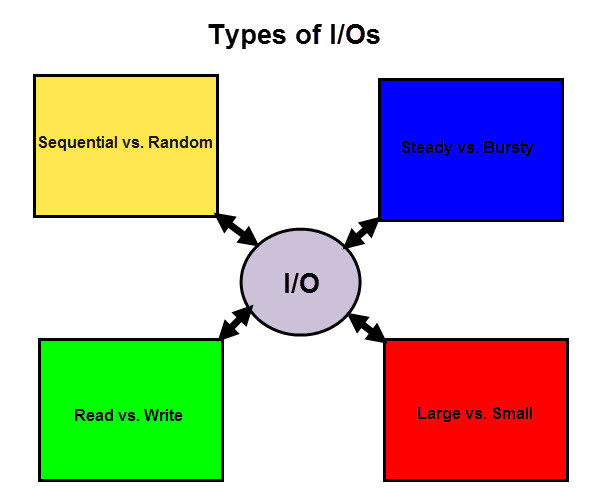
IOPS Types


Random versus Sequential I/O
Random vs. Sequential workloads is a good way to judge the efficiency of an application’s access and use disk space. Sequential data access is much faster than access. The reason is (without a deep dive) is random read access has a higher number of seek operation than Sequential. There fore if you have an application with a high random I/O then a drive with a fast seek time might be a good choice.


Steady vs. Bursty I/O
I/O traffic can be steady or bursty (spiky) just like NYC traffic! The traffic can change from burst to sequential over time. A good example is OLTP which can have bursty traffic during normal business hours then bursty during backup off business hours. Bursty is a bit of challenge as you need to calculate for it in the design as the storage needs to handle worst case (boot storm). It is important understand the nature of I/O produced by an application and look for patterns. Do we have 800% spike in I/O for 2 minutes between 2-3pm every day? More information = Better Design.


Read vs. Write I/O
Write I/Os consume more storage resources than read. We need to understand the ratio of read vs write for an application as this can be critical. For example, in a VDI environment, usually write is higher than write I/Os, however that can changes in the opposite direction in case of boot storm (all users login at same time), resulting in read I/Os 10 times or more higher than write which brings the whole environment to a stop. This could also influence Knowing the need for caching and its type.


Large vs. Small I/O
Applications transmit I/Os at different sizes. Some applications produce small block I/Os (4K/8K), while others produce large I/Os in MBs of data. For example, an application with 1K IOPS and 8K I/O size will consume fairly low bandwidth (8 MB/s). On the other hand, an application with a 32K I/O size will consume 4 times the bandwidth at 32 MB/s. Just to give you an idea of a typical I/O size for some major applications: Microsoft Exchange 2013 = 256KB. Microsoft SQL 2012 = 64KB.

As you see it is important to understand I/O size which will help the architect do a better design and make sure the storage will meet the applications needs adequately.

I hope this post will help you realize there is more to I/Os than just “average”. Understanding the nature of your applications I/Os workload is a key in any design.

Thank you for reading.

Nick

Sharing is Caring!

Something went wrong with the twitter. Please check your credentials and twitter username in the twitter settings.

Previous

iSCSI Requirments to Design

April 9, 2014
Next

Adobe and the Cloud

May 18, 2014

1 Comment

Mike

August 6, 2014

Really interesting, thank you.

Reply

Leave a Reply Cancel reply

This site uses Akismet to reduce spam. Learn how your comment data is processed.

Related posts

General, Storage,

Storage Performance Demystified: A Comprehensive Guide to IOPS, Latency, Throughput, and Beyond

Blackboard
Storage, VMware, vSphere,

SIMPLE calculation for sizing your VMware Datastore

Infrastructure Design & Architecture, Storage,

iSCSI Requirments to Design

Recent Comments

  • Pane on Cloud Chaos to Cloud Control: The Governance Playbook You Need Now
  • TJ on Cloud Chaos to Cloud Control: The Governance Playbook You Need Now
  • Mike A on Cloud Chaos to Cloud Control: The Governance Playbook You Need Now
  • Virtual Tarzan on Crafting an Effective Enterprise Multicloud Strategy
  • James on Crafting an Effective Enterprise Multicloud Strategy

Categories

  • AI-ML
  • Azure Architecture
  • Citrix
  • Cloud
  • Cloud Architecture
  • Cloud Security
  • Cloud Strategy
  • Compliance
  • Digital Transformation
  • EUC
  • General
  • Infrastructure Design & Architecture
  • IT Strategy
  • Networking
  • Storage
  • Troubleshooting
  • vCloud
  • VMware
  • vSphere

Archives

  • September 2024
  • July 2024
  • June 2024
  • March 2024
  • January 2024
  • October 2023
  • August 2023
  • July 2023
  • April 2023
  • February 2023
  • January 2023
  • September 2021
  • June 2021
  • January 2021
  • November 2020
  • July 2020
  • April 2020
  • March 2020
  • February 2020
  • January 2020
  • December 2019
  • November 2019
  • October 2019
  • September 2019
  • August 2019
  • July 2019
  • June 2019
  • May 2019
  • April 2019
  • March 2019
  • February 2019
  • January 2019
  • July 2018
  • April 2018
  • March 2018
  • February 2018
  • January 2018
  • December 2017
  • November 2017
  • October 2017
  • January 2017
  • October 2016
  • April 2016
  • March 2015
  • January 2015
  • November 2014
  • October 2014
  • September 2014
  • May 2014
  • April 2014
  • March 2014
  • February 2014
  • August 2013
  • March 2013
  • January 2013
  • December 2012
  • November 2012
  • October 2012
  • September 2012
  • August 2012
  • July 2012
  • June 2012
  • May 2012
  • April 2012
  • March 2012
  • February 2012
  • January 2012

Follow me

  • Home
  • About
  • Contact me

© 2019 http://virtualtarzan.com. All rights reserved.